New research: coal mine restoration in Wales
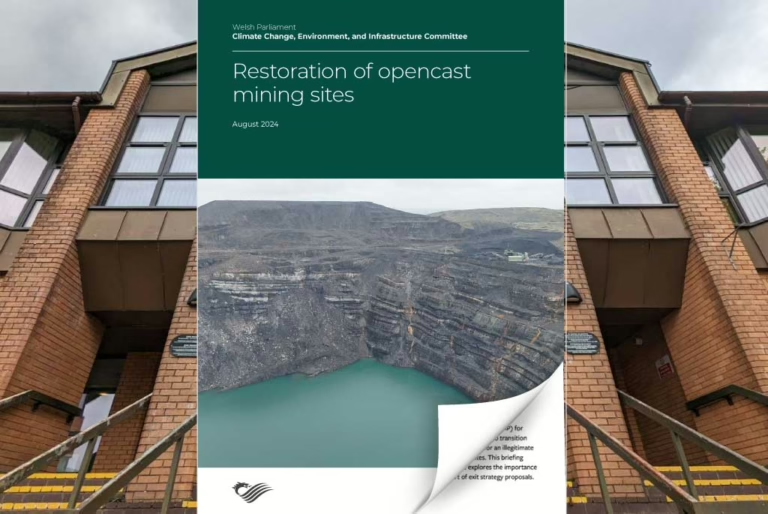
Click the image or here for the full report
Summary
Countless communities across the UK were - and still are - being sold a lie by their Local Planning Authorities and mining companies.
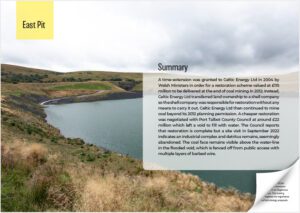
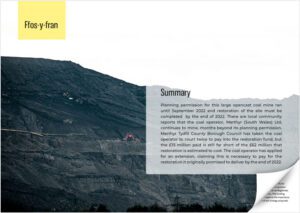
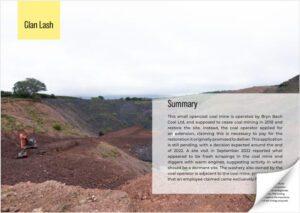
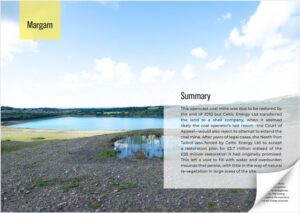
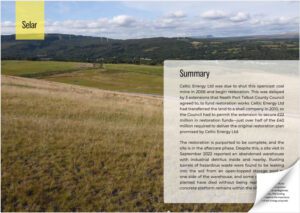
This report combines field and desk-based research to reveal the continuing failure of Local Planning Authorities to honour promises made to local communities about how, and when, nearby opencast coal mines would be restored. The research finds that mining companies have consistently evaded restoration costs, and continue to hold Local Planning Authorities to ransom in funding even the bare minimum restoration which would otherwise bankrupt County Councils who would be lumbered with a financial liability amounting to tens of millions. Field research indicates that event those sites which Local Planning Authorities have confirmed by email to be fully restored contains uncovered and leaking storage tanks of industrial chemicals, abandoned warehouses, concrete platforms, and no-go zones sectioned off with barbed wire. COP26 broke new ground, with claims the UK would 'move beyond coal' - but we risk leaving behind communities that cannot ‘move beyond coal’ as they continue to live with the localised impacts of a natural environment ravaged by up to 80 years of opencast coal mining. It is in this context, that we provide an update to some of the findings within the 2014 report on the state of coal mine restoration in South Wales, commissioned by the Welsh Government.
We hope this research will spark renewed calls for the vital restoration work still required, ensure plans for the restoration of coal tips is accompanied by restoration of voids, and sound a warning against consideration given to new or extended coal mining in South Wales and beyond.
Recommendations
- A fresh and independent assessment is needed to cost the task of properly remediating poorly restored and unrestored opencast coal mines in South Wales (and across the UK). It is then incumbent upon the Welsh and UK Governments to provide those funds to secure the restoration promised to local communities. A well-resourced and supported taskforce will be needed to facilitate this process and see restoration works through to completion.
- Key restoration decisions must be led by local communities and guided by the independent advice of Natural Resources Wales.
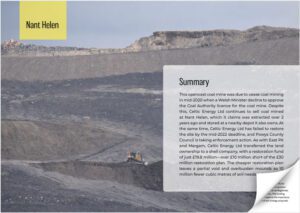
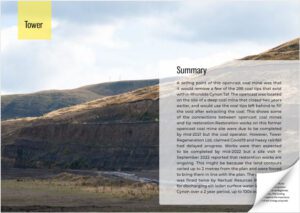
- Coal tips should be addressed together with voids remaining from opencast coal mining, rather than approached in isolation. 2,456 coal tips litter Wales. 2021 saw fresh calls for their reclamation amid fears of another Aberfan tragedy if the coal tips become unstable, estimated to cost £500-£600 million. Some restoration schemes remedy nearby coal tips whereas other poorly restored coal mines effectively create new coal tips, such as the overburden now to be left at the exopencast coal mine, Nant Helen. For this reason, coal tips and voids cannot be addressed in isolation.
- In the interests of transparency and accessibility, all planning authorities should make all Planning Officers’ reports available online and clearly identified alongside associated planning documents. Neath Port Talbot County Council Planning Authority, for example, confirmed it does not make their Planning Officers’ reports routinely available online. Planning Officers’ reports are generally written in more lay terms than, and comprehensively summarise, sometimes 100s of, highly technical documents associated with that application. The content of, and recommendation within, Planning Officers’ reports also greatly influence the outcome of a planning committee’s decision.