The Planning Playbook
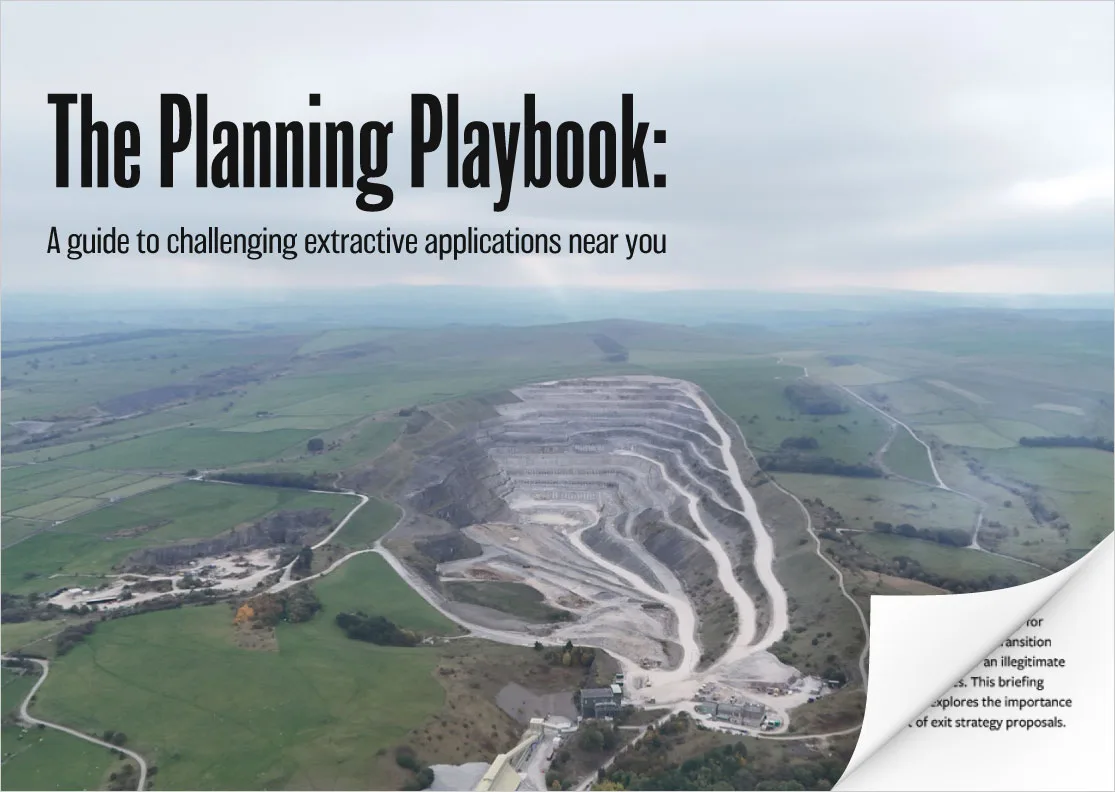
The Planning Playbook:
A guide to challenging extractive applications near you
Download the PDF or scroll down to read online
FOREWORD
This guide draws on 18 years of organisational knowledge fighting opencast coal mine applications. This was always shoulder-to-shoulder with local communities trying to preserve their local environment, way of life, and often motivated by the looming threat of global climate chaos.
Coal Action Network has existed since 2008. It started out as a few committed activists, with a founder working many unpaid hours, living in their van, and staying in the communities we worked in. This guide is thanks to their dedication. At the start, we were opposing about 40 live applications for new opencast coal mines and extensions. Now there are none.
We have witnessed first-hand the power of committed local campaigns successfully stop applications despite the deep pockets of developers and a planning system tilted in their favour.
The threat of opencast coal mines in the UK is hopefully over – but many of the tactics we learned along the way can be used for most extractive planning applications, from a tungsten mine to a quarry. We offer this guide to any group navigating the planning system to oppose an extractive development in their community.
"Never doubt that a small group of thoughtful,
committed citizens can change the world: indeed,
it’s the only thing that ever has."
- Margaret Mead
Methods of opposition
This guide focuses on action through the planning system, but Direct Action can be taken instead of, or alongside, action through the planning system. Any tactic where people take action to directly bring about the outcome they want, rather than trying to persuade institutions (courts, politicians, regulators) to act in their favour. This can be legal or illegal action, and accountable or unaccountable. An example of legal (at the time of writing) and accountable direct action would be ‘slow walking’ HGVs driving to or away from the site to develop it. This action involves walking slowly in front of the HGV, thereby delaying it – wear a high visibility jacket and do this carefully to maintain personal safety. Coal Action Network has historically supported direct action to oppose opencast coal mining. There are many guides on taking direct action on the internet, we recommend Seeds for Change’s guide.
This guide tries to help communities oppose extractive applications, such as quarries, via the planning system. It draws on CAN's experience since 2008 of standing alongside communities to face down opencast coal mine applications, often successfully.. If you live in one of these geographies, it’s worth double-checking the planning process where you are. This guide draws on Coal Action Network’s experience of supporting local communities to oppose opencast coal mining since 2008. Much of this experience is applicable to communities opposing any large development in their area, particularly extractive industries such as quarrying.
Forming a local campaign group
A local campaign group is just a group of people coming together in an area to campaign on a shared issue. After the issue passes, the group can stop meeting – or can go on to campaign on other issues that might matter to the group. Below is a summary of advice for forming and maintaining your local campaign group – but there is lots of advice on the internet. We recommend this guide.
Organising together as a group will:
- share the workload
- bring in more expertise, experience, and contacts
- reduce duplication in researching, writing arguments, and carrying out awareness-raising
- be a source of emotional support and momentum in what can otherwise feel like a David and Goliath scenario
There are various ways to go about kicking off a campaign group such as:
- Start a local Facebook or WhatsApp group and ask if neighbours want to join it. Use this to arrange or advertise a face-to-face meeting
- Organise a town hall meeting and advertise it on community noticeboards, Facebook groups, if you have enough budget, in the local paper
- Reach out to local environmental groups such as a local Friends of the Earth (FOE) group or park maintenance volunteers
The first meeting is high-stakes, you can lose people or win a committed core of the group. Here are some tips for a great first meeting of the new group:
- Don’t let the meeting last over an hour – better to meet again than to make it so long that no one wants to meet again – and advertise the length of time so people know what they’re committing to when they come.
- Remember your passion may not be matched by others in the meeting – meet people where they are at.
- Focus on the what and how of the group i.e. objectives, actions, and methods of communication between you – not the structure of the group or labouring over its name, logo etc. that can come later, if it’s needed at all.
- Try to ensure everyone has an action to do to feel involved, even if it’s a small or shared action.
- If possible, set the date of the next meeting in this meeting, even if it is pencilled in.
Top tip: tea and biscuits make every meeting better!
How you divide up the work will partly depend on how much there is to do and what capacities and strengths members of the group have. It may be sensible to group tasks as:
- Public outreach (flyers, social media, approaching other groups to speak about the application, etc.)
- Research (planning policy, application, key dates etc.)
- Official communications (emails to Local Planning Authority, MPs, Councillors, letter of opposition etc.)
- Group admin (facilitating, taking and sharing meeting notes, meeting reminders, maintaining a WhatsApp group etc.)
A significant planning application can take 6 months to 5 years to be decided. This uncertainty and length of time can make it challenging to maintain momentum in the group. Consider:
- Switching from regular meetings to meeting when something changes with the application if it is developing slowly or erratically.
- Broadening the remit of the group to work on other issues whilst the application is quiet.
- Pacing yourselves – this is unlikely to be a sprint unless you have come in at a late stage of the application.
Fundraising
At some point you will likely need some financial resources to fund things like:
- awareness-raising flyers
- venue hire and snacks for community meetings
- stall materials such as a banner, the table etc.
- legal advice
Depending on the application you are opposing, and whether legal advice is needed, you could require from £50 to over £100,000 (see Getting legal advice), so your fundraising activities will vary greatly depending on your funding requirements. There are guides to fundraising online – we like the Resource Centre’s guide, and their advice on taking card payments. Options for fundraising can include:
- online crowd-funders
- asking aligned and funded organisations for support such as Friends of the Earth
- QR to donate on flyers
- asking group members to chip in a small amount each
- running fundraising events such as a Ceilidh with a raffle
Unlocking the planning system
- Public consultation start/end dates – consultations must be at least 28 days for an application where an environmental impact assessment (EIA) is considered necessary.
- Local Planning Authority planning committee meetings – if the application is for a significant project, it is likely to be decided by councillors who are on the Local Planning Authority’s planning committee, usually at one of their regular meetings.
- If the decision refuses planning permission: the developer has a 6-month window to appeal that decision from the date of the decision.
- If the decision grants planning permission: anyone opposing that decision has up to 6 weeks to file for a judicial review challenge to that decision.
- Planning Officer – this is the main point-of-contact for a planning application and the person who will either decide its outcome, or recommend a decision to the planning committee in their planning officer’s report published just ahead of a planning committee meeting.
- Councillors – Councillors whose wards cover all or part of the area of the application are more likely to be vocal on the application (in favour or against) so are important to engage at an early stage. Planning committee councillors may decide the application outcome so are also vital to send information to against the application – but are unlikely to express strong views as they must remain ‘neutral’ until they have all the information to make a decision.
- Your local Member of Parliament/Member of the Senedd/Member of Scottish Parliament can be a useful source of support. They can sometimes squeeze answers and action out of your Local Planning Authority that you haven’t been able to. They can also write to the Secretary of State (England)/Welsh Ministers/Scottish Ministers/Department for Infrastructure (Northern Ireland) urging them to ‘call in’ a planning application to be decided by Government rather than the Local Planning Authority – anyone can do this, but it may unofficially be given more weight coming from a political representative.
- Planning Officer – this is the main point-of-contact for a planning application and the person who will either decide its outcome, or recommend a decision to the planning committee in their planning officer’s report published just ahead of a planning committee meeting.
- Councillors – Councillors whose wards cover all or part of the area of the application are more likely to be vocal on the application (in favour or against) so are important to engage at an early stage. Planning committee councillors may decide the application outcome so are also vital to send information to against the application – but are unlikely to express strong views as they must remain ‘neutral’ until they have all the information to make a decision.
- Your local Member of Parliament/Member of the Senedd/Member of Scottish Parliament can be a useful source of support. They can sometimes squeeze answers and action out of your Local Planning Authority that you haven’t been able to. They can also write to the Secretary of State (England)/Welsh Ministers/Scottish Ministers/Department for Infrastructure (Northern Ireland) urging them to ‘call in’ a planning application to be decided by Government rather than the Local Planning Authority – anyone can do this, but it may unofficially be given more weight coming from a political representative.
- Application form – this usually gives top-level information such as who is applying to do what. Some forms are more detailed than others. This is often the first document uploaded to a planning portal for a new application.
- Scoping opinion report – the applicant can request early guidance from the Local Planning Authority on whether an Environmental Impact Assessment is necessary and what should be included within its scope/assessed. This can give your group an early indication of what the Local Planning Authority thinks the project may impact. The scoping opinion can be requested before or after submitting an application.
- Environmental Impact Assessments (EIA) are prepared by the developer and reports on the potential for a development to positively or negatively impact many different aspects of the natural and built environment such as noise pollution, jobs, road safety, water quality etc., and mitigation of impacts.
- EIAs are often a long, detailed, and technical report with survey results and input from various technical experts such as ecologists, hydrologists, geo-engineers etc.
- A non-technical summary must be available too.
- An EIA is arguably the most important document and you should take the time to read it thoroughly. It can be a treasure trove of negative impacts that you can talk about when you write your opposition letter or if you encourage the local community to oppose the project.
- Statutory consultee responses:
- there are certain bodies, such as the Environment Agency in England, that the Local Planning Authority must consult with on certain types of planning applications.
- These bodies provide an independent view on whether the proposed development would comply with national legislation and policies relevant to that body’s focus. Where they highlight concerns, you can use this as further grounds to object to the application on.
- Their response letters should be uploaded to the Local Planning Authority’s online planning portal.
- Planning Officer’s report:
- alongside the EIA, this is one of the most important documents. It is also often a long document but should not be overly technical as it is written for planning committee councillors who often do not have a technical background.
- This document is intended to summarise sometimes hundreds of pages of planning documents including the EIA and statutory and public consultation responses. It also sets out whether the application is compatible with Local Planning Authority and national policies, and legislation.
- Crucially, the Planning Officer’s report also makes a recommendation to the Planning Committee on whether it should grant or refuse planning permission, which is often – but not always – enough to sway a Committee in one direction or the other.
- Unfortunately, this key report is often not published until just before the Committee meets to decide the application – usually 5 clear working days ahead of the meeting, but you can ask the Planning Officer to confirm this earlier in the application process.
- National planning policy ‘frameworks’: guidance documents from Government to Local Planning Authorities, who must apply the guidance when considering planning applications. These national guidance documents should align with international commitments such as the Paris Agreement. The guidance document is periodically updated, so it is good to ensure you look at the most recent edition by finding it on the government website, where it is updated.
- England: National Planning Policy Framework
- Wales: Planning Policy Wales
- Scotland: National Planning Framework
- Northern Ireland: The Strategic Planning Policy Statement
- Ministerial statements: A minister may issue a statement indicating a national priority that relates to development e.g. listing a new critical mineral. Local Planning Authorities should apply this to planning applications. A Ministerial statement may be made instead of updating a national planning policy framework if the scope of changes are small as Ministerial statements are relatively simple and fast to issue, but easy to undo by a new Minister.
- Depending on where you are, really key planning-related legislation includes:
- Town and Country Planning Act 1990
- Planning (Listed Buildings and Conservation Areas) Act 1990
- Planning and Compulsory Purchase Act 2004
- Planning etc. (Scotland) Act 2006
- Planning Act 2008 – England
- Planning Act (Northern Ireland) 2011
- Planning (Wales) Act 2015
- The Planning (Environmental Impact Assessment) Regulations (Northern Ireland) 2017
- Environment Act 2021
- Case-law: these are precedents set by court rulings on planning cases, for example a judicial review. It can be difficult to know what case-law is relevant and how to interpret and apply it to the planning application you are opposing. Solicitors that specialise in environmental planning law should be able to do this, if you have sufficient funding to obtain their services. Two high-profile recent court rulings that may be particularly relevant if the application you are opposing relates to extracting fossil fuels (click links for a full rundown):
- Finch vs Surrey County Local Planning Authority: Local Planning Authorities must include the impact of using the fossil fuels when deciding an application to extract them (UKSC/2022/0064
- West Cumbria coal mine decision: the argument that mining locally prevents the same amount of mining abroad (substitution) and therefore that there is no additional impact requires strong evidence to show that it is not additional. Impacts of extraction on climate change must also consider possible damage done to the UK’s role in leading international action on climate change (Case No: AC-2023-LON-000377)
- Local Plan: prepared by every Local Planning Authority to set out the longer-term vision, framework, and policies for future development, land use, and infrastructure within their area. It serves as the primary basis for deciding planning applications, ensuring development meets housing, economic, and environmental needs. If you can find parts of the Local Plan that aren’t compatible with a planning application, that could be a powerful argument against it.
- Other council policies: there may be council policies that do not directly relate to planning but can be applied e.g. if the Local Planning Authority has declared a climate emergency or NetZero commitments.
- Planning conditions (Section 106 of the Town and Country Planning Act 1990)
- Added when granting planning permission to make the development acceptable in planning terms, e.g. by requiring the development to meet specific standards regarding materials, operating hours, or environmental factors.
- Conditions must be necessary, relevant, and enforceable.
- Despite being legally binding, large developers often ignore conditions with impunity and Local Planning Authorities relax conditions once development has begun.
- Scope 1, 2, 3 emissions/ impacts
- Scope 1: Direct emissions – emissions from sources that a company owns or controls directly
- Scope 2: Indirect energy emissions – emissions from the generation of electricity, steam, heating, or cooling purchased by the company. The company does not have direct control over how the product is being generated but emissions from the product are the result of the company’s purchase/use of the product.
- Scope 3: Value chain emissions (indirect) – all indirect emissions not included in Scope 2 that occur in the company’s upstream and downstream value chain. The bulk of emissions are usually in scope 3, but also the hardest to accurately quantify.
- Upstream/downstream impacts
- Upstream: anything required to make and supply the inputs for the development e.g. an upstream scope 2 impact of a cement works would be coal mining to supply coal to the cement works to burn and produce heat needed to make cement.
- Downstream: anything associated with whatever the development leads to e.g. a downstream scope 3 impact of a cement works would be the contribution to landfill from old concrete when demolishing cemented structures as concrete does not break down.
- Material planning considerations
- Factors that must be weighed up by a Local Planning Authority when deciding a planning application e.g. is it in the public interest, or does it result in biodiversity net gain. If, for example, you opposed the application because you didn’t like the developer’s company logo, that would not be material to the Local Planning Authority’s consideration of a planning application.
- Statutory consultants
- Organisations and bodies who must be consulted on relevant planning applications
- Often consulted before public consultation
- Includes organisations like the Environment Agency, Highways agency etc.
- Delegated decision
- Councillors delegate some of their authority to make planning decisions to Planning Officers on minor planning applications such as an extension to a house to save time
- Roughly 90-96% of planning applications are decided by Planning Officers
- Local Planning Authority
- A local planning authority is the specific department within a council responsible for managing land use, processing planning applications, and enforcing planning laws
- Local plan
- Prepared by every Local Planning Authority to set out the longer-term vision, framework, and policies for future development, land use, and infrastructure within their area.
- Environmental impact assessment (EIA)
- Prepared by the developer and reports on the potential for a development to impact many different aspects of the natural and built environment such as noise pollution, road safety, water quality etc.
- Planning Officer’s report
- Prepared by the Planning Officer for the council’s planning committee to summarise all the information received about an application and consultation responses.
- Recommends that the committee either grants or refuses of an application.
Pre-application
It is common for developers to carry out pre-application engagement with the Local Planning Authority and public consultation to test the waters before submitting a full application form, at which point significant changes are harder and more expensive to make. Sometimes a developer at this stage is also trying to determine if a development is worth pursuing and has little invested. So there is an opportunity here to persuade a developer not to take a proposal further – but be aware sometimes a developer will file an application years after this initial pre-application phase.
To dissuade a developer taking an application further, you want to convince the developer that they are unlikely to gain planning permission or it will take a long time with strong local resistance – uncertain delays are likely to cost the developer more and make b`udgeting difficult. You can do this by:
- Encouraging initial local opposition to the application may convince the developer that they would struggle to convince Council that the proposed development is in the ‘public interest’, needed for a grant of planning permission.
- Writing letters of opposition at this stage will go straight to the developer who may not represent these views in any subsequent planning application it lodges. Therefore, if you think local residents only have the enthusiasm to write once, it is better to save their energy for the forthcoming public consultation, should the developer file a planning application.
- At this early stage you may wish to get key people to write in to the Council opposing the proposed development such as affected ward councillors, MPs/MSs/MLAs/MSPs, closest residents to the proposed site, and existing groups such as Green Party, FOE, and faith-based groups. Early opposition from these key people and campaign groups are more likely to make the developer think twice about taking the proposal further.
- The Local Planning Authority will issue a ‘screening opinion’ which determines whether the application requires the developer to undertake an Environmental Impact Assessment (EIA) which most significant extractive projects will require, as well as what impacts must be considered within the EIA (see below for more on EIA developments).
- If the scoping opinion does not require an EIA and you think it should, or if it does not need to consider some impacts you think the development could have, immediately write to your MP/MS/MLA/MSP and campaign groups, and consider seeking legal advice from solicitors that specialise in environmental and planning law. Solicitors ostensibly charge by the hour – sometimes in 12-minute increments! So keep communications with the solicitors focused and concise, and if there is something you can do e.g. finding contact details for planning councillors, it’ll be cheaper if you do it for the solicitors. You can also directly ask your Local Planning Authority to expand the scope of the EIA described in the ‘scoping opinion’ to include specific impacts you think it could have and why, but it is less likely to have much influence.
The Local Planning Authority may not list a proposal on its planning portal until a formal application has been made by the developer. So, if you hear of a development proposal:
- Search that developer’s name to see if you can find any information relevant to the proposal in the news or on the developer’s own website.
- Contact your Local Planning Authority and ask for details relating to the proposal including any scoping opinion that has been provided.
- You can simultaneously submit a Freedom of Information/Environmental Information Regulations request (you don’t need to know which of the two categories your request falls within and it’ll be treated largely the same) to your Local Planning Authority.
- This is a legal entitlement for anyone to request information held by any public body. You should request emails (with attachments) and meeting notes between the Local Planning Authority and the developer, and any scoping opinion requested or provided. More on using FOI/EIR requests later on in this toolkit.
- Check your Local Planning Authority’s weekly planning lists which show what planning applications were received over the previous week, and whether it will be decided by the Planning Officer or a full planning Committee (better). If the developer submits a formal application, you’ll see it here. Weekly planning lists are available on the planning section of your council’s website, email the Local Planning Authority if you cannot locate them.
Application
Once an application has been received by a Local Planning Authority, it will be uploaded to the Local Planning Authority’s online planning portal which is normally a section within the council’s website. It can take a few days for the application to appear on the online planning portal. Not all online planning portals are the same, but most have a ‘key word’ search function, you can try to find the application this way. If that does not locate the application, email the planning department for the application’s planning reference or a link to it in the online planning portal – you can usually find an email address for the planning department in the planning area of the council’s website. A planning reference often looks something like P/25/0037, is unique, and can be used to find the application in the online planning portal.
Top tip: bookmark the planning application page as you will want to check this page frequently for any new information/progress on the application.
Sometimes application forms are very brief and just fulfil formalities without much detail. This detail will come later in the EIA, or sometimes supplementary documents from the developer such as a planning outline or a survey. However, there is usually some useful information:
- The application should name the developer – this could be a person or a company. Search this name online if you haven’t already during the pre-application stage. Look for any negative press about other developments they are responsible for. Search the developer company or/and company director’s name on Companies House, which provides free information about companies in the UK. You can find out if the company has financial issues, or if the Director has also been the Director of other companies with bad press/a pattern of bankruptcy and bad debt.
- If the developer is represented by an agent, perhaps the agent could be contacted and convinced to cut ties with the developer to save its reputation.
- Make a note of the address of the proposed site if this wasn’t already known.
- Check the date on the application and compare to the date listed for when it was uploaded to the online planning portal – if it took more than a normal working week to upload to the online planning portal, complain to the Local Planning Authority. Inform it that you’ll escalate this further if future documents relating to this application are unduly delayed between being received and appearing on the online planning portal.
- If the application is down for “delegated decision” it means that the Planning Officer will consider and decide whether to grant or deny planning permission. Generally larger or more controversial developments will be decided by the Planning Committee (made up of Councillors). It is preferable that the Planning Committee decides an application we oppose as there is more scrutiny, we might get to speak against it at the Planning Committee hearing, and we have more leverage since Councillors want to be re-elected.
- If an application is assigned for a ‘delegated decision’, write to every Councillor on the Planning Committee, as well as your ward Councillor, stating the reasons why they should require the application be decided by the Planning Committee instead – they have the power to change it.
If the application requires an EIA, the Local Planning Authority is required to give a 28-day public consultation some time after the EIA is made available (generally on the online planning portal – it could instead be made available for viewing in paper-based form at the council offices but we haven’t known this to happen for years). If the application does not require an EIA, the Local Planning Authority is only required to give a 14-day public consultation (or 21 days if it is not published in a newspaper). If you can convince the Local Planning Authority to extend the public consultation (see below), or repeat it, it can be useful as it will delay the application which would likely weaken the developer’s business case for the development and may eventually contribute to the developer pulling out. In very rare instances, the Local Planning Authority may determine a planning application before the consultation ends.
Public consultation (EIA and non-EIA)
- There must be public notices up before the public consultation can begin so look out for paper notices up on telephone masts and gates etc. in the area around the proposed development, as well as in the local press. If paper notices are wet and illegible, or torn down, photograph this and send it to the Local Planning Authority Planning Officer immediately with the location, date, and time it was observed. If you think this may lead people not to know about application, request an extension to the consultation period from the date the notices are restored.
- If there are any changes to the planning application and associated documents that could be material to planning consideration (e.g. a new geotechnical survey), during or after the consultation period, demand a new public consultation is launched by the Local Planning Authority as the information on which the original consultation took place must have been inaccurate or incomplete so that consultation should be treated as inadequate. If the Local Planning Authority refuses to do this, it may be open to a judicial review challenge if planning permission is subsequently granted.
Your objection to the planning application
Send in your own objection during public consultation. You can draft it before the consultation begins so you can get it in early, but also so you have as much time as possible to encourage others to object within the public consultation period. Objections can be sent in after the consultation period, but Planning Officers are not obligated to consider those – though still worth submitting as they often do get considered in our experience. Coal Action Network has a sample consultation response.
- When you send in your objection, it’s a good idea to send it to at least the Planning Officer dealing with this application, your ward councillor, and every planning committee councillor. Planning committee councillors’ contact details are usually listed on the council website – contact your council if you are unable to find them.
- Try to make sure you object on grounds that are material to planning permission e.g. disruption, safety concerns, noise, eyesore (AKA ‘loss of visual amenity’), etc.
- The main source of information for your objection will be in the EIA – highlight how negative impacts have been under-estimated and positive impact over-stated, such as job creation. It’s a good idea to use clear sub-headings so no points are missed by busy Planning Officers.
- If it is an extension to an existing application, document breaches of current/recent planning conditions and disruption e.g. dust, working outside of permitted hours etc. ideally with some form of photo/video evidence. This will jeopardise the developer’s likelihood of winning an extension.
Other people’s objection to the planning application
A planning application must be in the ‘public interest’ to be granted planning permission. The more people who write in to object to the planning application, the more likely it will be that the Local Planning Authority will decide it is not in the public interest. The greater the impact of the proposed development on the person objecting, the more weight that objection is generally given. That usually means residents living closest to the development, or along roads leading to the site that may see increased HGV traffic. Therefore, it is good to focus your energy on these people writing objections to the Local Planning Authority, and including their address in emails/letters.
Encourage people to object to a planning application by:
- Holding stalls in busy high streets with postcards that passers-by can fill out with a sentence or two about why they oppose the application, their name, and their address. You can post or hand-deliver these to the council Local Planning Authority. It is a good idea to photograph these before giving them to the council in case it “loses” them, or if you want to refer to the reasons people object later on, perhaps to the press. You can try to apply for permission to have the stall, but we find it’s easier to ask for forgiveness than permission – just be aware it’s illegal to take donations on the stall in the street without permission.
- Knock on people’s doors. This can be intimidating for you but generally residents will want to know about developments being proposed that could impact them – and may give you useful details about the proposed site or surrounding area that can be used as additional grounds to object upon e.g. the site’s access road floods every Autumn.
- Post about the application in local social media and WhatsApp groups with links to an online objection form (if that exists) or to the application and the email address people can write their objections to. Encourage people to share the post themselves to get the word out. You can provide a sample letter to the Council which will likely result in more people objecting but each objection which is the same will be counted as a ‘petition’ rather than a letter, which is given less weight by the Council. Generally, quality over quantity, but a petition could be a useful additional tool to show public opposition if you can get enough signatures.
Check the Planning Committee meeting agendas to see if the development you oppose is due to be considered in the next meeting (usually monthly). The agendas are usually published online about a week before the meeting. If you can’t find it on the Council’s website, email the Planning Officer and ask where you can find the agenda, and when agendas are generally published online.
- If you submitted a letter (email) of opposition during the public consultation, you can apply to speak in person at the Planning Committee meeting.
- The Council may only permit one or two speakers opposing the application and may only allow around 5 minutes per speaker, so prepare well for your punchy, persuasive speech. Prioritise factors that will count as ‘material planning considerations’ and, if you can, coordinate raising different points to any other speakers opposing the application. By this time, you’ll have read the Planning Officer’s report, so it’s a chance to point out any shortcomings in that report – be bold!
- The process of applying to speak at a Planning Committee meeting differs by Council, but you must typically register your interest with the local council's Democratic or Committee Services 2-3 working days in advance of the meeting and some Councils have a ‘request to speak’ form on the planning area of their website.
- Councillors may be susceptible to shows of public opinion. Therefore, it may be a good idea to get as many people outside of the Council chambers as possible on the day of the meeting with banners and placards. The council may sneak councillors into the meeting via a back entrance so it’s a good idea to also make lots of noise so they can’t miss you. Urging attendees to bring pots and pans can work well and be fun.
- Whether or not you have a slot to speak, Committee meetings are public so you all have the right to crowd into that room after your demonstration outside – although security may require you to leave your banners and any other campaign paraphernalia outside the Committee meeting room.
- The capacity of the room may also be limited although ideally, they would find a way to accommodate everyone such as finding a larger room or setting up a virtual link to the meeting in another room.
- This is another opportunity for Councillors to see the public opinion against the application, and feel under scrutiny for what they say and how they vote in that meeting.
- Make a note of how Councillors vote and what they say (you may want to share out this task with other people in your group). This can be useful to identify future allies and liabilities on any similar applications to come.
- It is likely that the application will be one of a number of applications discussed in that meeting – but if you all crowd into the room, they may well bump it up the agenda to get rid of you all again, you don’t have to stay for the rest of their meeting!
- Decision meeting outcomes can be tricky to predict – so it is good to prepare in advance two press releases, for both a grant and a refusal of planning permission. There are many guides online for how to write a press release. The press will likely ask for a reaction directly after a decision is announced – a prepared press release allows you to make the most of this moment. You can even send both press releases to journalists ahead of the decision so they have it to hand when the decision is published – making it more likely your views will be included in any press coverage, like this example.
Congratulations! You successfully fended off an extractive development in your area… but it might not be over – sorry. The developer may now choose to do one of three things:
- Appeal the refusal within 6 months of the decision (note the date in your diary so you know when the window has closed). Appeals are decided by a planning inspector.
- Re-apply with an application that has been changed to reduce opposition to it. If the developer reapplies within 12 months, they don’t pay a further application fee, meaning some try their luck even if the odds are still against them.
- Accept the refusal and move on – if they do this, they will likely still respond by saying that they disagree with the decision and will consider appealing it, even if they have no intention to do so.
If the developer thinks there will also be vocal local opposition to an appeal or an amended application, they may decide it is less likely to be successful or they don’t need that headache – and move on. Therefore, it is good to celebrate a refusal loudly to let the developer know you’ve still got energy for the fight, and underscore in your press release that any similar applications in the future will also be fought against by the local community.
This can be gutting, particularly given all the evenings spent poring over planning jargon and days of whipping up local opposition to the application. The planning system is tilted in favour of big developers and the impacts on your quality of life and nature unfortunately take a back seat, even if not officially. Cash-strapped Local Planning Authorities also sometimes approve planning applications just to avoid big developers’ costly appeals against refusals, which can run over £100,000.
But all may not yet be lost. Whether decision was made by the Local Planning Authority, a Planning Inspector, or by a Minister, if they failed to consider some factor that was material to planning – or failed to give that factor sufficient weight – when making the decision to grant the application planning permission, you may be able to quash (negate) the planning permission with a judicial review challenge, forcing the Local Planning Authority to reconsider the application.
Planning decision 'call in'
Ordinarily planning applications are decided by the Local Planning Authority (by either the Planning Officer or the planning committee). However, occasionally a planning application for a significant development will have impacts beyond its immediate surroundings or create widespread controversy. In these cases (look up all the grounds), if the government thinks that the Local Planning Authority cannot give these factors due consideration, it may choose to call in the application to be decided by the Government. If an application is determined the Local Planning Authority, it cannot subsequently be called-in. However, an application is often not called in until the Planning Officer’s report is published – so there is a small, nail-biting window of time in which you’ll find out if the application will be called in.
Be aware that very few planning applications are called in – only 198 planning applications were called in between 2010-2023, that’s 1 in every 23,000. Of the 43 planning applications called in 2019-2023, 60% were subsequently granted permission – a successful call-in doesn’t mean an application will get rejected.
How to get a planning application called in
- Email call-in requests to one of the addresses listed below depending on the location of the application.
- Technically, the number of call-in requests doesn’t affect the decision of whether to call in the application – it’s based on the argument and evidence presented in the call-in request. However, in practice, lots of call-in requests indicate widespread controversy which is one of the grounds to call in the application. So, it’s a good idea to get as many individuals and organisations to send in individual letters, and not just from the local area.
- Anyone can request that a planning application is called in and, technically, who makes the request should not affect its consideration for call-in… but in practice it is a good idea to get your MP to also submit a call-in request if you can as it may in practice carry more weight.
England -
- Call-in decision by: Secretary of State
- Call-in requests to: pcu@communities.gov.uk
- Further information: https://researchbriefings.files.parliament.uk/documents/SN00930/SN00930.pdf and gov.uk/guidance/called-in-planning-applications
Wales -
- Decision by: Welsh Ministers
- Call-in decision by: PEDW.casework@gov.wales
- Further information: gov.wales/calling-planning-applications-guidance-html
Scotland -
- Call-in decision by: Scottish Ministers
- Call-in requests to: dpea@gov.scot
- Further information: gov.scot/publications/planning-applications-call-in-ministerial-statement-28-june-2023/
Northern Ireland -
- Call-in decision by: Department for Infrastructure
- Call-in requests to: planning@infrastructure-ni.gov.uk
- Further information: infrastructure-ni.gov.uk/topics/regionally-significant-developments-and-called-applications
Process of a called-in application
- A called-in application will follow a similar process to what the Local Planning Authority follows but is more rigorous. In this situation the role of the Planning Officer is taken up by a Planning Inspector who will gather all the facts of the case and run a further public consultation – just as the Planning Officer does – and will present the evidence and make a recommendation to a government minister, who in this situation replaces the decision-making function of the Local Planning Authority’s Planning Committee.
- It is advisable to get legal representation to put your arguments forward if an application is called-in, as the developer will hire big-shot lawyers at this stage, and it will get highly technical.
- If the Minister decides to grant the developer planning permission, but you think the Minister did not consider everything that is relevant, or didn’t give it enough consideration (perhaps because the Planning Inspector failed to), you can issue a judicial review challenge. You would definitely need legal representation at this stage. The Courts are generally negative towards judicial review cases but strong ones have successfully overturned Ministers’ grant of planning permission. This doesn’t mean the planning permission is rejected, but it forces the Minister to reconsider it. This happened with the West Cumbria coal mine planning permission, which was subsequently rejected.
- If the Local Planning Authority seems intent on rubber-stamping the application through, a called-in application will be considered by a Government that is not so easily swayed by local priorities and politics, and may give a fairer balance to national priorities such as climate change commitments.
- It will further delay determination of planning permission, which may be enough for the developer to withdraw its application depending on its business model and finances.
Judicial reviews
Judicial reviews can be daunting… but can also be a successful last-ditch effort to stop an extractive project near you. Judicial reviews recently prevented oil drilling in Surrey and a huge underground coal mine in West Cumbria.
- Judicial reviews require specialist professional legal advice on whether you have a strong case. We use and recommend Richard Buxton Solicitors who are specialists in environmental and planning law. However, there may be legal campaign groups who will take on the case pro-bono (for free) such as Good Law Project, Lawyers for Nature, and the Environmental Law Foundation. If your solicitor believes you have a strong case, they will make an application on your behalf for a judicial review hearing.
- Applications must be lodged within 6 weeks of the grant of planning permission. Before lodging an application, there generally needs to be some “pre-action” correspondence where you (or your solicitor) explain to the Planning Authority where they have made mistakes. The Planning Authority will invariably reply with thinly veiled contempt for how absurdly wrong you (or your solicitors) are, in the hope of convincing you not to apply for a judicial review hearing.
- 80% of applications for a judicial review hearing are refused.
- Of judicial review applications that make it through to a final hearing, only 30-50% are won by the claimant (that’s you).
- If you lose, your liability to pay the defendant’s (Local Planning Authority) legal costs is capped at £5,000 – this is often a small fraction of the defendant’s actual legal costs. Your liability is limited thanks to the Aarhus Convention designed to protect individuals challenging environmental threats in their area.
- Judicial reviews can be drawn out over many months, or even years, and your own legal costs can spiral to over £50,000 – so fundraising is essential. There are guides online with tips on how to fundraise legal costs. It is possible for you to self-represent but your likelihood of success would be much lower and you may accidentally misstep through the tricky judicial review process resulting in it being thrown out. It is a good idea to check first whether organisations like the Good Law Project or the Environmental Law Foundation might take the case and fund it instead.
Getting legal advice
Getting legal advice from solicitors that specialise in planning and environmental law has a number of benefits.
- Understanding: Planning law is fairly dense and involves a lot of case-law that is difficult to apply properly by a lay (not legally trained) person.
- Impact: Although it technically shouldn’t make a difference, a letter on a solicitor’s letterhead to a planning department or Councillors on the weaknesses of a developer’s application tends to carry more weight than the same arguments made by a local campaign group. This may also be because the Council will fear an appeal against its decision if there are solicitors involved.
- Psychology: As a local campaign group, you can feel brow-beaten by a Council. Having solicitors on your side can feel like you’re levelling the playing field and it can be very uplifting to watch the Council get flustered by your solicitor brow-beating them instead.
However, solicitors’ costs can rapidly spiral and planning applications have been successfully opposed by local campaign groups without involving solicitors. Solicitors ostensibly charge by the hour – sometimes in 12-minute increments! So, keep communications with the solicitors focused and concise, and if there is something you can do e.g. finding contact details for planning councillors, it’ll be cheaper if you do it for the solicitors. Agree your budget and deliverables with the solicitors from the outset so that everyone is clear what the expectations are. We use Richard Buxton Solicitors, who specialise in environmental and planning law. They also have a great deal of experience helping oppose extractive projects. However, there may be legal campaign groups who will take on the case pro-bono (for free) such as Good Law Project, Lawyers for Nature, and the Environmental Law Foundation.
Depending upon what stage you involve solicitors, they can have a less or greater impact – generally the later the stage, the more worthwhile it is to involve solicitors.
- Pre-application stage: Some developers are just testing the waters and for many reasons will not pursue a planning application, so hiring a solicitor at this point is likely to be a waste of money. This is also because there’s not the detail for the solicitors to get into at this early stage.
- The Council’s EIA scoping report guidance (see planning keys): Solicitors could try to persuade the Council at this stage to include wider impacts in its guidance to the developer… but this guidance is only indicative and solicitors can argue for the inclusion of wider impacts later.
- Planning application: this is usually a fairly high-level overview filled out form. There’s not really much for solicitors to get stuck into for the purposes of opposing the application.
- EIA: The Environmental Impact Assessment is usually a chunky document that explains how the application would make its environmental and social impacts acceptable. EIAs should be written in a way that makes them accessible to the public, but can be technical in places and quite overwhelming, with some extending to over 80 pages. Hiring a solicitor at this stage can highlight what the key weaknesses are in the EIA that you might miss. However, statutory consultees such as the Environment Agency may identify those same weaknesses when they are asked to give an opinion on the EIA – creating expensive duplication. The developer might submit further surveys if the Council and statutory consultees identify flaws in the EIA too, which then cost more solicitor time to read through updated application documents.
- Public consultation: usually at this stage all the material details of the application are available. So this may be a good point at which to hire a solicitor – and if they are able to point out significant flaws in the EIA and any surveying, it could greatly delay the applicant, who would then need to provide additional information – which in turn would necessitate – a new round of public consultation. A recent application to downgrade the restoration of an opencast coal mine in South Wales had to run 3 public consultations for this reason. However, paying a solicitor to read through potentially hundreds of pages of planning documents could be very expensive. If the decision is a ‘delegated decision’ (made by the planning officer), this might be your last chance to involve a solicitor before the decision is made.
- Planning Officer’s Report: This is usually made available with a minimum of 3 clear days before the crunch decision meeting, and summarises the many planning documents into one, fairly lay, report to the Councillors with a recommendation to approve or refuse planning permission. If the recommendation is to refuse planning permission, you might decide to save money and hope Councillors follow that recommendation. If the recommendation is to approve planning permission, this is probably one of the most effective and cheapest points at which to get a solicitor on board ahead of a decision. The solicitor would read the Planning Officer’s Report and write a letter to each Councillor listing the fundamental flaws of that Report, threatening a judicial review should Councillors approve the application.
- Approval decision: See ‘Tactics’ for more details, but essentially at this stage if you want to challenge the decision to approve planning permission, this is done via a judicial review and for that, bringing solicitors on board is almost essential – but is also a significant financial undertaking that could cost over £50,000.